
FG-055 – Imperial German jack (Kriegsschiffgösch), 1903–1918

Flag ID: FG-055
Flag facts
- Maker (stamp): None
- Dimensions: 70 × 100 cm
- Materials: wool bunting, cotton hoist header, braided hemp rigging
- Construction: Printed
- Layout: Imperial naval jack, 1903 pattern
- Markings (hoist): crown-over-M + “1”, “GÖSCH – 0,7 × 1,0 m”
- Legal stamp expansion (if relevant): Imperial property mark
- Acceptance: Imperial acceptance stamp (crown-over-“M” + “1”)
- Period: 1903–1918
- Condition: operational wear, moth damage
Context & Use
In German naval terminology, a Gösch is the small jack flown at the bow jackstaff of a warship when the vessel is at anchor or moored. It functions as a national or service identification mark in harbour, complementing the larger war ensign at the stern.
On Imperial German warships the Kriegsschiffgösch carried a simplified version of the national or war flag arranged as a separate rectangular flag. It was normally hoisted:
- when the ship was in harbour or at anchor,
- during ceremonial occasions, inspections and official visits, and
- in combination with the war ensign at the stern or mainmast.
Unlike masthead command flags or full-size war ensigns, the size of a jack does not map directly onto the size of the ship. Contemporary practice appears to have used size groups of jacks that provided a visually balanced flag at the bow, rather than a strict table tying each jack size to a particular ship class or tonnage. A 70 × 100 cm jack such as FG-055 therefore represents a smaller service jack within the 1903 system, but it cannot be used to identify a specific vessel type on its own.
Because each ship needed only a small number of jacks, and because these smaller flags were heavily used in everyday harbour service, surviving examples of Imperial jacks are noticeably scarcer than full-size war ensigns.
Comparative notes – pre-1903 vs. 1903 jack

Image: Ratisbons, Kriegsmarine war flag / jack (archival reference).

Pre-1903 pattern (1867–1903)
From 1867 until 1903, the German naval jack showed the black–white–red tricolour with a relatively compact Iron Cross in the centre. Contemporary reconstructions suggest that in this earlier pattern the height of the cross was around five-ninths of the flag height (~0.56), resulting in a comparatively narrow, modest cross with long “open” colour fields around it.
Visually, this produced a more open tricolour where the stripes remained dominant and the Iron Cross read as a central emblem rather than as the main field of the design.
1903 modification – the type used on FG-055
On 26 September 1903 the Imperial authorities issued new regulations modifying both the war ensign and the naval jack. The most reliable explanation found in contemporary naval documentation does not refer to a single saluting incident but to a broader recognition problem: the bars and thin elements of the Imperial war ensign were regarded as too narrow and could be misread at distance or in poor visibility, particularly in comparison with the British White Ensign.
As a result, the war ensign received a redesign with thicker elements and increased visual weight to improve long-range identification at sea. In the same regulatory update, the naval jack was modified in parallel to maintain visual and symbolic consistency with the updated ensign.
The most significant visible change was the enlargement of the Iron Cross. The pre-1903 pattern used an Iron Cross measuring approximately 5⁄9 of the flag’s height (~0.56), whereas the 1903 design increased this to about 2⁄3 (~0.67). In practical terms this made the arms of the Iron Cross roughly 20% thicker and visually dominant across the entire field.
A surviving pre-1903 jack is not available within the present comparative sample, but reconstructions published by Flags of the World (FOTW, “Germany: Naval Jack 1867–1903” and “Naval Jack 1903–1918”) provide reliable proportional data for both the early and the 1903 pattern. These reconstructions show the compact 5/9 cross height of the pre-1903 design clearly, allowing a direct numerical comparison with the measurements taken on FG-055.
No primary source has yet been identified that provides a separate, stand-alone justification for altering the Gösch beyond its alignment with the broader 1903 redesign of Imperial naval flags. The matter therefore remains under ongoing research.


The physical dimensions of FG-055 confirm the 1903 pattern mathematically. The flag’s total height is approximately 73 cm, while the Iron Cross measures about 48 cm from the upper to the lower outer black edge. This gives a ratio of 48⁄73 ≈ 0.66, which falls squarely within the 2⁄3 height range defined for the enlarged 1903 cross and clearly above the earlier 5⁄9 (~0.56) proportions of the pre-1903 jack.
The purpose of the 1903 redesign was straightforward:
- to increase the recognition distance of the German jack,
- to reduce confusion with other tricolour-based naval flags at sea, and
- to emphasise the Prussian military identity of the Imperial Navy through a stronger Iron Cross.
Where FG-055 fits
FG-055 clearly belongs to the post-1903 enlarged-cross pattern. The Iron Cross is broad and visually dominant, with a wide white fimbriation and arms extending deeply into the stripes. This matches the proportions documented for the 1903–1918 jack, rather than the more modest cross of the 1867–1903 design.
4. Comparison with the 1933 “Alter Art” (first-pattern Nazi revival)
When the National Socialist regime came to power in 1933, naval flag policy briefly reverted to Imperial imagery. The enlarged-cross 1903 Imperial war ensign and its matching naval jack were reintroduced almost unchanged as the first-pattern Reich war flag and jack, later referred to as Alter Art.
In practice the revived 1903 pattern under the Nazis was used both as Kriegsflagge and as Gösch, depending on size and assignment. This explains why surviving examples can show mixed hoist markings, with some pieces labelled as war flags and others as jacks, even though the basic artwork is identical.
Compared with the original Imperial jack, the key visual innovation of the Alter-Art implementation is the introduction of a continuous white fimbriation around the Iron Cross. This ensures that the full outline of the cross remains visible even where the arms extend into the black stripe — a feature never present on authentic Imperial-period jacks (1903–1918). It is the most reliable single diagnostic feature for separating a true 1903 Imperial jack from a 1933 Alter-Art flag.
The transitional period from 1933 to 1935 also saw the black–white–red tricolour reinstated as a national flag, coexisting with new swastika-based national and party flags. In 1935 a new Reich war flag with a large central swastika and an Iron Cross was decreed, replacing both the revived Imperial pattern and the earlier dual-flag arrangement. This second-pattern war flag remained in service until 1945.
The following comparison shows the overall differences between the Imperial 1903 jack (FG-055) and the 1933 Alter-Art revival, including close-up views of the Iron Cross on both flags.


Reference note – Weimar naval jack vs. Weimar war ensign:
The Weimar-era Gösch is included here for comparison only. It uses an Iron Cross in the
pre-1903 proportions (narrow arms, compact form), placed on black–white–red stripes with a
black–red–gold canton.
This design must not be confused with the Weimar Kriegsflagge, which looks similar at a glance but
carries an Iron Cross much closer to the post-1903 enlarged style (thicker arms, stronger visual
weight).
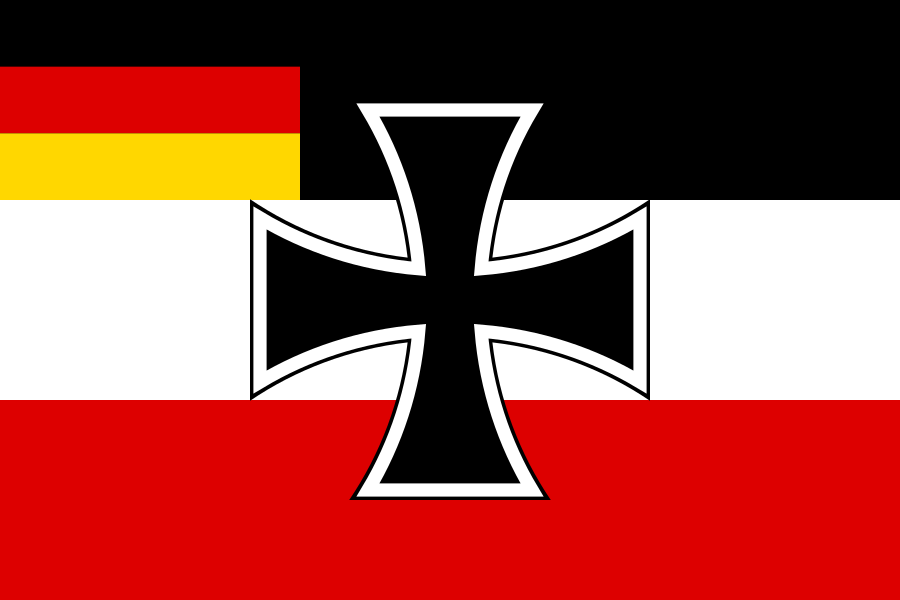
(Image: Wikipedia, public domain)
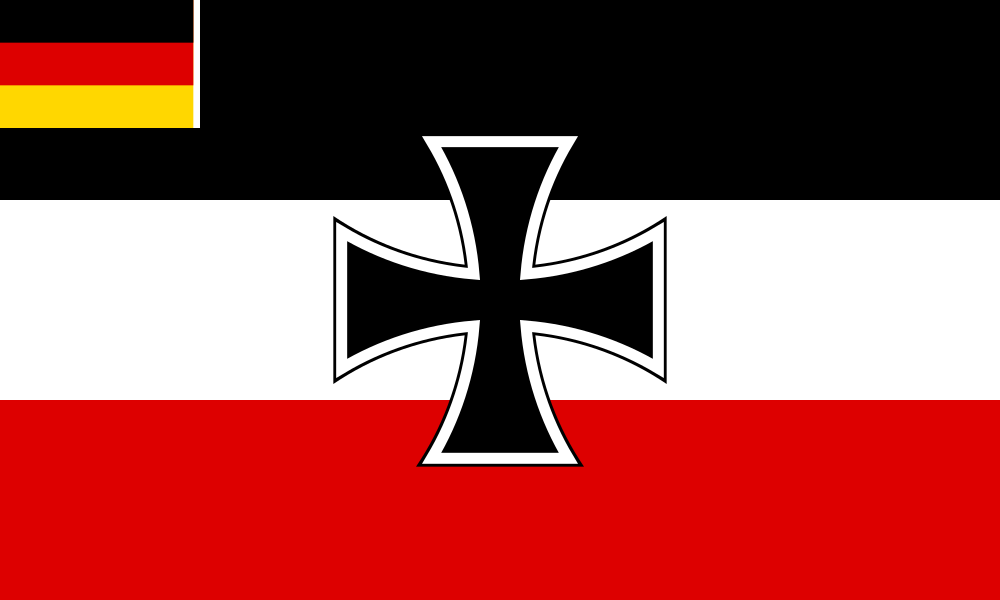
(Image: Wikipedia, public domain)
A full documentation of the Weimar war ensign is available here:
Weimar Republic Naval Ensign – FlagGeek Study
.
The Alter-Art pattern is fully documented in the dedicated FlagGeek study of the 1933–1935 transitional war flag:
Reichskriegsflagge Übergangsmodell
.
Additional images


Sources & References
- Imperial regulations of 26 September 1903 — Amendment defining the enlarged Iron Cross for both the war ensign and the naval jack (Gösch). Referenced in: “Dienstvorschriften der Kaiserlichen Marine – Flaggen und Standarten”, 1903–1904 editions.
- Kaiserliche Marine hoist markings — Crown-over-"W" acceptance marks as seen on FG-055 correspond to acceptance stamps documented in: Reichs-Marine-Amt textile inspection and procurement records (1890–1918), Bundesarchiv RM-3 and RM-5 collections.
- Imperial jack proportions (pre-1903 and 1903 patterns) — Dimensional breakdowns and reconstruction data from FOTW: FOTW – German Empire Naval Flags 1871–1918 .
- Jack 1871-1918 (Germany) FOTW – German jack Flags (Historical Overview) .
- Weimar naval jack & war ensign — Illustrative reconstructions used for comparative analysis sourced from: Wikipedia – List of German Flags .
- Weimar Kriegsflagge (1921–1933) — Technical documentation and breakdown: FlagGeek – Weimar Republic Naval Ensign .
- Reichskriegsflagge “Alter Art” (1933–1935) — Transitional characteristics, adoption, white outline around the Iron Cross, and dual use as Gösch/Kriegsflagge: FlagGeek – Reichskriegsflagge Übergangsmodell .
- Early Imperial jack visual reference — High-resolution archival photos of pre-1903 and early German naval designs used for comparative analysis: Ratisbons – Kriegsmarine War Flag (archival auction reference) .
- Imperial-era textile construction — Wool bunting types, marine stitching patterns, header canvas structure, and ropework standards documented in: Kaiserliche Marine Beschaffungsrichtlinien (1895–1918) and Heeresdruckerei textile standards, archival microfilm.
- Direct measurements — All FG-055 dimensions, proportions, hoist features, acceptance marks, stitch structure and material analysis recorded by FlagGeek (2025).
Comments
Post a Comment